
Velocity isn't everything in recruiting, but it opens the door. Coaches use it as a first filter, and the bar keeps rising. The average Division 1 fastball is now around 89 mph, and top programs average in the mid-90s.
So how hard should you be throwing, and when? We've sent more than 450 high school players on to college or professional baseball. Here's what their velocity looked like at each stage.
These are the averages for VeloU athletes who went on to play in college or pro ball:
Compare that to the average Division 1 fastball of about 89 mph and the picture is clear: most pitchers who play at the next level are still climbing during their junior and senior years. Read the full breakdown in How Hard Should My Son Be Throwing?
On a 90 mph fastball, a hitter has a fraction of a second to decide whether to swing. Every extra mph shrinks that window. That's why college coaches lean on velocity: it's one of the clearest signs a pitcher can compete at their level.
Velocity isn't the only thing that matters. Command, pitch shapes and competitiveness all count. But if you're well below the benchmarks for your grade, coaches may not watch long enough to see the rest.
Being behind as a freshman or sophomore is common, and it's fixable. Velocity is trainable. The pitchers who catch up usually do three things well:
Strength is one of the biggest drivers of velocity. Young pitchers who build real strength in the weight room give themselves room to throw harder.
Many pitchers leave velocity on the table with inefficient mechanics, often in the lower half. A video breakdown shows exactly where.
Velocity gains only matter if you stay healthy. Arm care, workload tracking and a smart ramp-up after time off keep you on the mound.
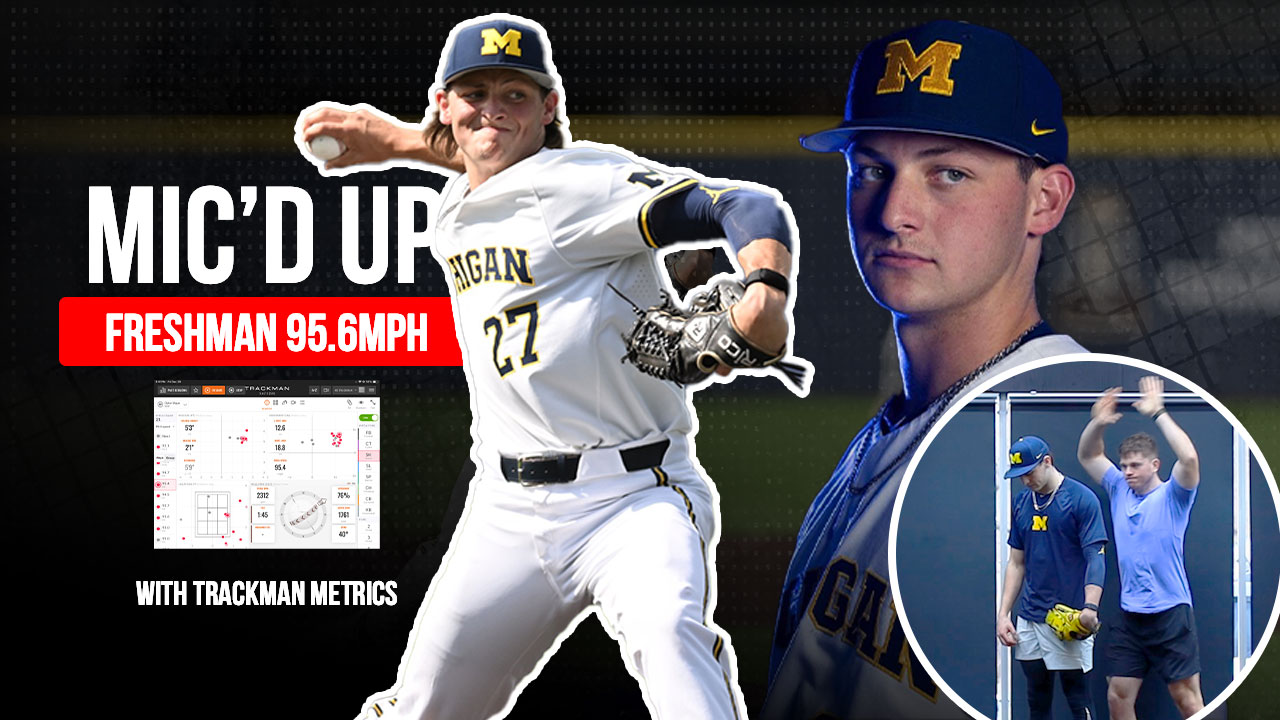
Dylan Vigue was throwing 88-91 mph as a high school senior when he started training remotely with VeloU. By focusing on his lower half, strength and arm care, he reached 95-96 mph, became a starter at the University of Michigan and was drafted by the Kansas City Royals in the 7th round of the 2026 MLB Draft. Read Dylan's story.
Gary Gill-Hill started at VeloU in 9th grade, "very undersized and raw." He built strength, refined his mechanics and got drafted out of high school. He's now up to 98 mph in Triple-A with the Mets.
The fastest way to improve is to find out exactly what's holding you back. That starts with an evaluation of your mechanics, strength, mobility and arm health, followed by a plan built for you.
The average Division 1 fastball is about 89 mph. Most VeloU athletes who went on to play in college averaged around 87 mph as juniors and seniors and were still improving.
VeloU athletes who went on to play in college averaged about 83 mph in 9th and 10th grade. If you're below that, there's plenty of time to catch up with the right training.
It varies by athlete. VeloU's remote athletes average a 3.5 mph gain in their first six months of training.
Yes, when it's done with a plan. Good velocity training includes strength work, arm care and workload tracking, not just throwing harder more often.